
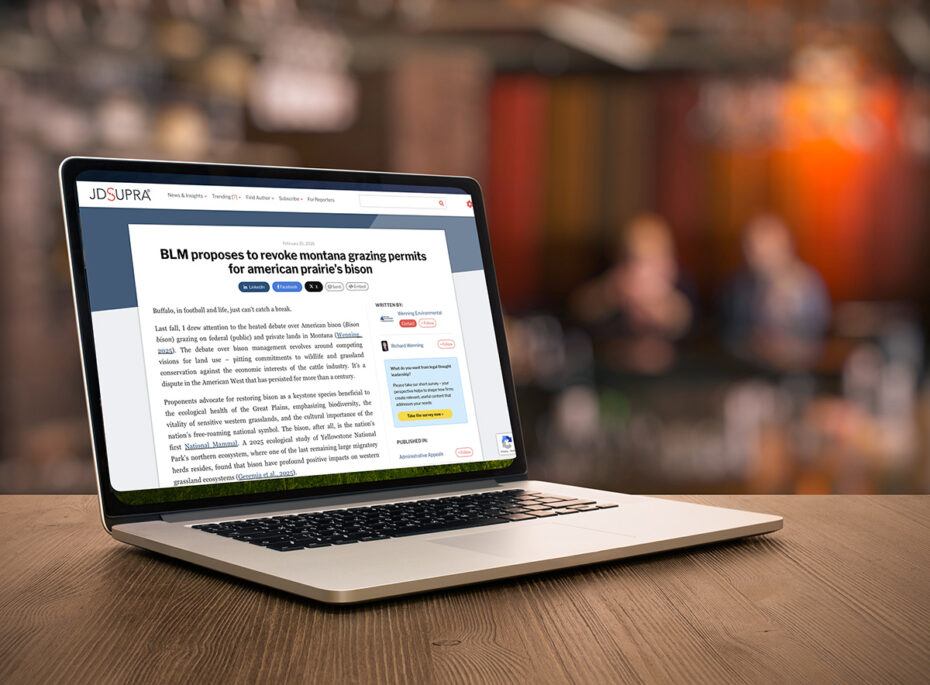
Media Share from JDSUPRA on February 25, 2026
Buffalo, in football and life, just can’t catch a break.
Last fall, I drew attention to the heated debate over American bison (Bison bison) grazing on federal (public) and private lands in Montana (Wenning, 2025). The debate over bison management revolves around competing visions for land use – pitting commitments to wildlife and grassland conservation against the economic interests of the cattle industry. It’s a dispute in the American West that has persisted for more than a century.
Proponents advocate for restoring bison as a keystone species beneficial to the ecological health of the Great Plains, emphasizing biodiversity, the vitality of sensitive western grasslands, and the cultural importance of the nation’s free-roaming national symbol. The bison, after all, is the nation’s first National Mammal. A 2025 ecological study of Yellowstone National Park’s northern ecosystem, where one of the last remaining large migratory herds resides, found that bison have profound positive impacts on western grassland ecosystems (Geremia et al., 2025).
Opponents, mainly ranching interests, contend that bison compete with cattle for limited forage on public lands, transmit the brucellosis disease that induces abortions in pregnant cattle, and cause significant property damage in the absence of costly specialized fencing to contain such an agile and powerful animal.
Recent regulatory actions favor the cattle industry and, if federal decisions are upheld, may limit the future movements and size of bison herds in the American West.
In December 2025, the Trump Administration’s U.S. Department of the Interior (DOI) Secretary Doug Burgum instructed the Bureau of Land Management (BLM) to reevaluate the grazing authorization approved by the Biden Administration in 2022. The Secretary claimed that the Taylor Grazing Act of 1934 stipulates that grazing on publicly owned federal lands should be “limited to cases where the animals to be grazed are domestic and will be used for production-oriented purposes.” The key legal question is whether bison qualify as “livestock” for federal grazing permits under the Taylor Grazing Act and related authorities.
A month later, in January 2026, the BLM announced its proposed decision to revoke grazing permits on 63,000 acres of federal land in Montana held by the non-profit western conservation organization American Prairie to sustain its bison herd. The distinction between livestock and wildlife was BLM’s basis for its proposed decision, characterizing American Prairie’s bison herd as managed as wildlife, not for production. BLM’s decision reverses its own 2022 bison grazing authorization.
For American Prairie, BLM’s proposed decision affects more than the size of its bison herds. American Prairie aims to connect and restore 3.2 million acres of the West’s short-grass prairie ecosystem. Its restoration strategy links privately owned land with nearby federal allotments, enabling bison to graze across public and private boundaries instead of being confined to isolated patches. If bison are barred from grazing on federal lands, American Prairie’s vision of a network of connected bison habitat cannot function under a framework traditionally used for cattle, forcing it to rethink its landscape-scale ecological restoration and bison management strategies.
American Prairie filed its protest of the proposed decision with BLM on February 6, 2026. The Coalition of Large Tribes (COLT), an intertribal organization representing more than 50 tribes with the largest land holdings and over half of the Native American population, also filed protests. The Tribes warn that BLM’s proposed decision could effectively bar Tribal bison herds on federal lands nationwide, jeopardizing treaty rights, food sovereignty, and cultural survival.
According to Earthjustice, BLM’s recent shift to excluding bison from livestock grazing permits has broad implications beyond American Prairie and the permits involved. Despite 40 years of general 10-year livestock grazing permits for bison, the reversal of BLM’s long-standing interpretation of grazing statutes could threaten 41 current grazing permits for bison ranchers across six western states.